Zurich · Switzerland · On the Limmat
Zurich Old Town
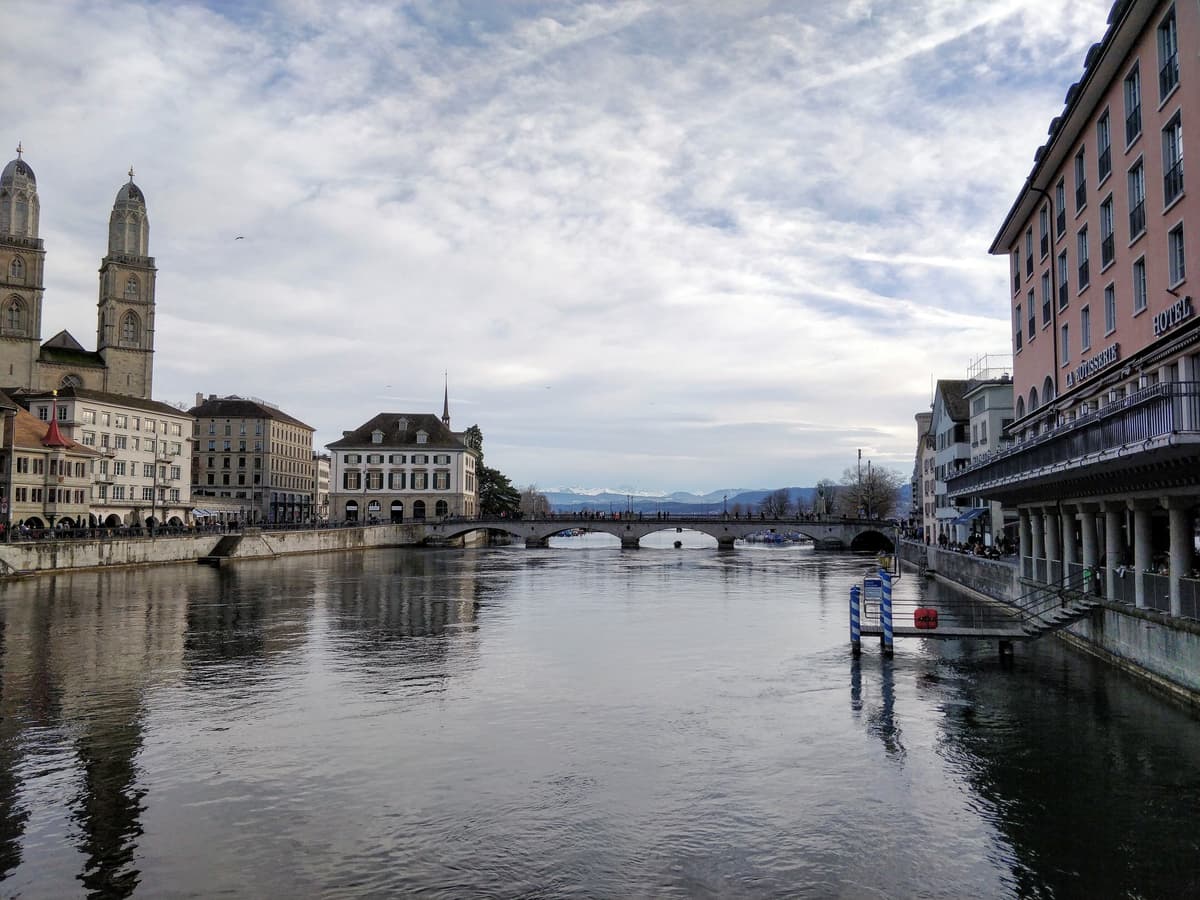
Zurich Old Town is Zurich's medieval center, spread over both banks of the Limmat from Zürich HB south to the lake. The Grossmünster and the Niederdorf are on the right bank, the Fraumünster, St. Peter and the Lindenhof on the left. Both banks have pedestrian zones, and the Rathausbrücke in the middle is 12 min on foot from the station.
Updated
Key facts
- Where
- Both banks of the LimmatFrom Zürich HB (Zurich main station) to Lake Zurich
- Historic town
- 0.62 km²Kreis 1, named Altstadt, is larger
- From Zürich HB
- 12 min on foot850 m to the Rathausbrücke
- Trams through the middle
- Trams 4 and 15Rathaus and Helmhaus, on the Limmatquai
- Pedestrian zones
- On both banksDeliveries 05:00 to 12:00; bicycles pushed
- Language
- GermanPrices in Swiss francs (CHF)
- Grossmünster
- Scaffolded until autumn 2027Church and tower stay open
The two banks of the Limmat
The Limmat divides the Old Town in two. The right bank, the historic Mehrere Stadt, has one long main street that changes its name as it runs south: Niederdorfstrasse, Marktgasse, Münstergasse, and Oberdorfstrasse. Gabled houses of four to five stories line it in closed rows.
The left bank, the Mindere Stadt, rises to the Lindenhof and St. Peter on their hills, with the Fraumünster down by the river. Its narrow lanes and squares have smaller houses of three to four stories. On both banks most houses date from the 13th to the 19th century.
Left bank
Right bank
- Bahnhofbrücke
- Right bank: PolybahnUp to the Polyterrasse from Central
- Mühlesteg
- Right bank: NiederdorfLanes, shops and bars
- Rudolf-Brun-Brücke
- Left bank: LindenhofThe hill of the Roman fort, with the view
- Left bank: AugustinergassePainted oriel windows
- Rathausbrücke
- Right bank: RathausThe town hall over the river
- Left bank: St. PeterThe church with the large clock face
- Right bank: Guild housesOn the Limmatquai
- Right bank: GrossmünsterZwingli's church, the twin towers
- Münsterbrücke
- Left bank: FraumünsterChagall's windows, on the Münsterhof
- Left bank: ParadeplatzOn Bahnhofstrasse, with Sprüngli
- Right bank: WasserkircheThe church on the river
- Quaibrücke
- Left bank: BürkliplatzThe boats on the lake
- Right bank: SechseläutenplatzWhere the Böögg burns
- Zürich HBZurich main station; 12 min on foot to the Rathausbrücke.
- LindenhofA square on a hill, on the left bank.
- AugustinergasseThe lane with the painted oriel windows.
- St. PeterThe church of St. Peter, below the Lindenhof.
- FraumünsterThe left-bank church with the Chagall windows.
- ParadeplatzThe square on Bahnhofstrasse, between the station and the lake.
- BürkliplatzWhere Bahnhofstrasse meets the lake and the boats leave.
- PolybahnThe funicular from Central up to the Polyterrasse.
- NiederdorfThe quarter of lanes on the right bank.
- RathausThe town hall, built out over the water from the Limmatquai.
- Guild housesGuild houses on the Limmatquai.
- GrossmünsterThe twin-towered church where Zwingli preached.
- WasserkircheThe church on the Limmatquai, beside the Helmhaus.
- SechseläutenplatzThe square by Bellevue, at the lake.
What to see in Zurich Old Town
Grossmünster
The twin-towered church where Zwingli preached: no entry fee, and 187 steps up the Karlsturm.
Fraumünster
Marc Chagall's five choir windows, on the Münsterhof; paid entry.
Churches
St. Peter, whose clock face is 8.64 m across, the Wasserkirche, the Predigerkirche and the Augustinerkirche.
Lindenhof
The hill of a Roman fort, now a public square shaded by lime trees, more than 20 m above the river.
Guild houses
The houses of the guilds on the Limmatquai and the Münsterhof, and the ones with restaurants open to everyone.
Museums
The Cabaret Voltaire, where Dada began, Museum Strauhof, Zunftstadt Zürich and the Kunsthaus at the edge; free or paid.
Viewpoints
The Polybahn's 100-second ride from Central to the Polyterrasse, the Lindenhof and the Karlsturm.
History
From the Roman customs post of Turicum to Zwingli's Reformation and the walls that came down.
A first walk across both banks
From Zürich HB to Central, the route crosses the river once: 2.8 km, or 38 minutes of walking before any stops.
Bahnhofstrasse and up to the Lindenhof
From Zürich HB, walk down Bahnhofstrasse and turn left into Rennweg. Pfalzgasse climbs to the Lindenhof without steps.
St. Peter and Augustinergasse
Back down Pfalzgasse, a stairway on Schlüsselgasse climbs to St. Peterhofstatt and the church of St. Peter. From Münzplatz below it, Augustinergasse and its painted oriel windows lead on.
The Münsterhof and the Fraumünster
The Fraumünster stands on the Münsterhof, the Old Town's largest square, with Chagall's windows in its choir.
Across the river to the Grossmünster
The Münsterbrücke crosses the Limmat to the Grossmünster and its twin towers.
Through the Niederdorf to Central
Münstergasse and Niederdorfstrasse lead north through the Niederdorf to Central, where the Polybahn starts.
Walking tour
The route step by step, with its steps and slopes, a one-hour loop and the guided tours.
Map
The sights, tram stops, named fountains, parking garages and public toilets, with the walk to each.
Niederdorf
The lanes of the right bank, their shops and bars, and the Niederdorf at night.
Augustinergasse
The left-bank lanes: Rennweg, the Schipfe, Weinplatz with the Roman baths and the Münsterhof.
Limmat
The Limmatquai, the Rathaus, the bridges, the river baths and the Limmat boat.
Lake Zurich
Round trips by boat from Bürkliplatz, at the south end of the Old Town.
When to go
At the Zürich / Affoltern weather station (444 m), summer days in July, the warmest month, reach 25.1 °C on average; January, the coldest, has a mean of 1.0 °C. Even the driest month, February, has 55 mm of rain; the weather month by month gives rain, sun and snow.
From May to September the river baths, the Frauenbad and the Männerbad, are open. Sechseläuten, the guilds' spring festival, falls on the third Monday in April in most years. The Christmas markets open on a Thursday in the second half of November and close on December 23 or 24.
Eating, shopping and staying
Restaurants
Zürcher Geschnetzeltes and other Zurich dishes in beer halls, guild houses and cafés, with their price levels.
Fondue
The restaurants with cheese fondue in every season, and winter fondue in gondolas, on a boat and in a tram.
Chocolate
Sprüngli on Paradeplatz since 1859, the chocolatiers of the lanes and where to drink hot chocolate.
Bahnhofstrasse
The shopping street from Zürich HB to the lake, Paradeplatz, Swiss souvenirs and the Sunday sales.
Hotels
Hotels on both banks, by the lake and by the station, and the lower-priced stays.
Plan your visit
Getting there
Trains from Zurich Airport every 10 minutes, the walk from Zürich HB, trams, tickets and the Zürich Card.
Parking
The parking garages at the edge of the Old Town, their prices and the blue zone.
Weather
Temperatures, rain and snow month by month, and the events of the year by season.
Christmas
The Christmas markets in the Niederdorf, on the Münsterhof and at Zürich HB, and the Lucy lights.
Sechseläuten
The guild parade through the Old Town and the burning of the Böögg on the Sechseläutenplatz.
Things to do
The Old Town first, then the lake, the Polybahn and the rest of Zurich.
Nearby
The Uetliberg, the zoo, Lindt Home of Chocolate and day trips by train.
What is under works
The Grossmünster, scaffolded until autumn 2027
In 2026 and 2027 the whole church is scaffolded, its towers included, while the canton restores its outer shell. The church and the Karlsturm stay open, and most of the scaffolding comes down in autumn 2027.
The Rathausbrücke, rebuilt until 2029
The bridge between the two banks is being replaced. On foot, a passage along its north side stays open, and to the south a temporary bridge takes pedestrians and bicycles. Its market is held on the Stadthausquai until summer 2028.
Good to know: toilets, water, Sundays and tips
Public toilets
The city runs more than 100 ZüriWC toilets. Unstaffed ones are free; staffed and wheelchair-accessible ones cost CHF 1. The staffed ones are in ShopVille under Zürich HB, at Bellevue and Bürkliplatz, and under Paradeplatz. The map shows the others in and around the Old Town.
Drinking fountains
All of the city's more than 1200 fountains run with drinking water. About 320 of them, most of them the historic fountains of the Old Town, are fed by a separate spring-water network.
Sundays and public holidays
Shops set their own hours from Monday to Saturday; the law puts no limit on them. Sundays and public holidays are closing days, apart from four Sunday sales a year set by the city; the next is on November 29, 2026. The 180 shops of ShopVille under Zürich HB open every day.
Paying and tipping
Prices are in Swiss francs (CHF). Cards are accepted almost everywhere, and many places also take euros and give change in francs. Tipping is not required; in many restaurants guests leave about 10 percent or round up.
Steps and wheelchairs
The left bank climbs to the Lindenhof and St. Peter. Pfalzgasse leads up to the Lindenhof without steps, while St. Peterhofstatt is reached by a stairway; the walking tour marks each. The city's website plans routes for people with impairments, tried first in Kreis 1 from 2023.
Cars and bicycles
The Niederdorf, from Central to Bellevue, and the left bank between the Rudolf-Brun-Brücke and the Rathausbrücke, the Lindenhof and the Münsterhof included, are pedestrian zones. Pedestrians have priority there; deliveries drive in only from 05:00 to 12:00, at walking pace, and bicycles are pushed. Drivers use the parking garages at the edge.
The name: Altstadt, Kreis 1 and the Dörfli
In German the Old Town is the Altstadt. Kreis 1, the first of Zurich's 12 city districts, carries the same name but is larger. It covers the city as it was until 1893: 1.80 km² in four quarters, Rathaus, Hochschulen, Lindenhof, and City. The historic town is the quarters Rathaus and Lindenhof, 0.62 km².
Inside its walls, which had 16 towers, the town had two halves: the Mehrere Stadt, or "grosse Stadt", on the right bank and the Mindere Stadt, or "kleine Stadt", on the left. "Dörfli" is the locals' name for the Niederdorf and the Oberdorf together.
In English, Zurich is said "ZOOR-ik". In German the city is Zürich, and the name begins with a "ts" sound: "TSUE-rikh". German is the official language, and the city's dialect is Züritüütsch.
Frequently asked questions
Where is Zurich Old Town?
Zurich Old Town is the center of Zurich, on both banks of the Limmat from where the river leaves Lake Zurich north toward Zürich HB. It is the historic heart of Kreis 1, the city district named Altstadt. The Rathausbrücke in its middle is 850 m from the station, 12 min on foot.
Is Zurich French or German?
German. The constitution of the canton of Zurich makes German its official language, and the city's own dialect is called Züritüütsch. The Old Town's names are German too: the Altstadt, the Niederdorf on the right bank and the Grossmünster.
How do you pronounce Zurich?
In English, Zurich is said "ZOOR-ik", with the stress on the first syllable and a voiced z, as in "zoo". In German the city is written Zürich, with an umlaut on the u, and the name begins with a "ts" sound: "TSUE-rikh". In German, too, the stress falls on the first syllable.
Do you tip in Zurich?
Tipping is not required in Switzerland. In many restaurants, though, guests leave about 10 percent or round the bill up. Prices are in Swiss francs; cards are accepted almost everywhere, and many places also take euros and give change in francs.
Is Zurich safe for visitors?
The UK government's travel advice says Switzerland has a low rate of serious crime, with more reports of petty theft in larger cities. It advises taking care against bag-snatching and pickpocketing at airports, at railway stations and in crowded areas. The advice covers the whole country and does not name Zurich.
Can you drink the water from Zurich's fountains?
Yes. All of the city's more than 1200 fountains run with drinking water, and each one is checked and cleaned once a week. A fountain is first of all for drinking: bathing in one can be dangerous for small children, and dogs do not belong in it.